The War That Ended Five Times
The Iran war has been declared finished at least five times. Yet the blockade is still in place.

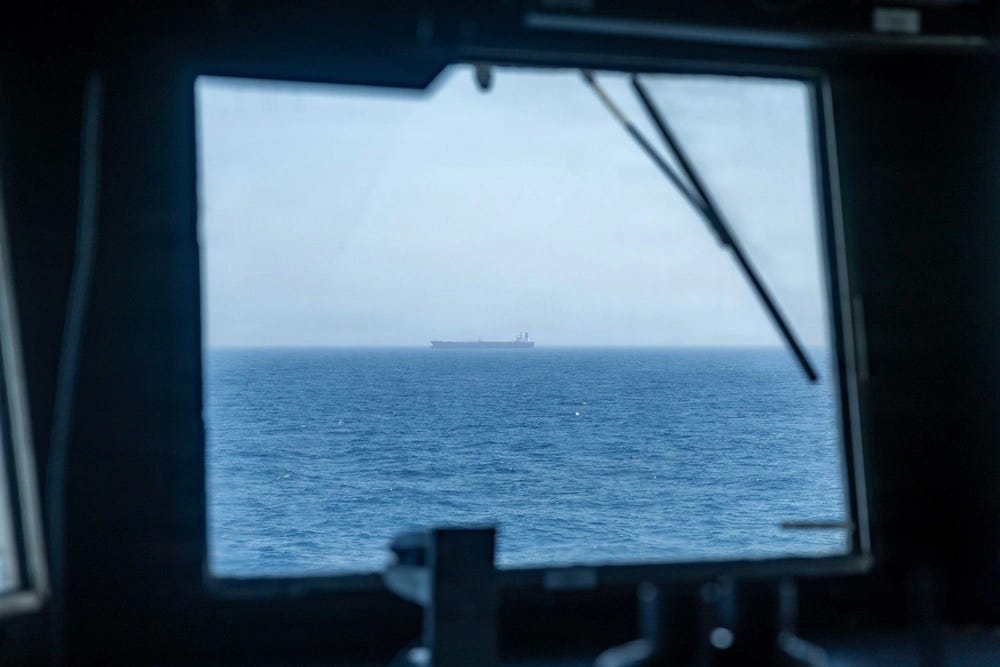
While American and Israeli strikes were still reaching new parts of Iran, ten days into the war, Donald Trump told CBS that the war was “very complete, pretty much”. Two days later, at a rally in Kentucky, he said the war had been over “in the first hour”. On 1 May he wrote to Congress that “the hostilities that began on February 28, 2026 have terminated”. On 25 May he called the war “largely over”. And on Monday, 9 November, after meeting Qatar’s prime minister, he said that “Iran militarily is effectively over”. That same night, according to Iranian state television, American strikes hit Qeshm Island.
So, by Trump’s own account, the war has ended five times. I am not counting July, when Trump declared the ceasefire “over” and the bombing started again. You could read these statements as predictions that kept going wrong. I read them as boasts with a job to do. They were meant to reassure voters at home and steady the markets, so that the war could go on without pressure building on him from abroad. Each did that job for a while, until the next strike overtook it.
In March I wrote about how this war was first described as an “excursion”. That word made the war sound small before it had even begun. “Effectively over” comes from the same vocabulary, used at the other end. It tells markets, voters and Congress that the war has ended. In Iran, the blockade and the strikes go on, and in law that means the war goes on too.
The March claims came in the second week of the war. Their message to Americans was that the war had already been won. By declaring the war won, Trump was preparing Americans, and the wider world, to see whatever came next as tidying up. Tidying up needs no justification, so he no longer had to explain how the war was being fought.
The May ending matters most, because it was a constitutional act, and it showed how little the Constitution weighed with Trump. Under the War Powers Resolution of 1973, a president who takes the country to war has sixty days to end the fighting or get Congress to approve it. Trump told Congress about the war on 2 March, so his sixty days ran out on 1 May. The day before, Pete Hegseth told the Senate Armed Services Committee that the ceasefire meant “the 60-day clock pauses or stops”. On the deadline itself, Trump wrote to the Speaker that there had been no exchange of fire since 7 April and that the hostilities “have terminated”. Reason said at the time that he was pretending the war was over.
I work on legal language, and I read “terminated” as a word chosen for what it was intended to do. A war that has ended needs no permission from Congress, so the word removed the need to ask. Six days later, American forces struck military sites in southern Iran and Tehran. Senator Richard Blumenthal had already put it plainly: “The blockade alone is a continuing act of war.”
Congress let it pass. The Republicans who controlled both houses said they would defer to Trump, although the Constitution gives the power to make war to Congress, not the president. Its silence did more to empty the War Powers Resolution than Trump’s letter did. I doubt Congress would have looked away so easily if the country under blockade were not a Muslim one.
In July Trump declared the ceasefire over, and the strikes resumed. The November ending came at his first meeting with a foreign leader since his party lost both houses of Congress. In February I wrote about how diplomacy had turned into the language of deals. The same habit is now being applied to a war. The announcement does the work that a real settlement would have to do.
On Monday Trump added a word: “effectively”. It says more than he may have meant, because something that is effectively over is over in practice but not in fact. So to call a war effectively over is to admit that it has not ended, while still claiming the rewards of an ending: falling oil prices, a calmer public and fewer awkward questions from a Congress his party will lose control of in January. Nothing in the sentence commits Washington to lifting the blockade or stopping the strikes.
Look closely at the sentence, too. Trump did not say the war was over. He said Iran was over. It was the headlines that changed it to “the war is over”. If a country is militarily finished, the next strike on it is easier to explain. A country that is “over” cannot really be at war with anyone. It can only be kept under control, and that is how Trump talked about Iran for the rest of his answer.
The United States, he said, was “just keeping it the status quo”. When reporters asked why he did not simply declare the war ended, he said the blockade was a matter of regional security. A few days earlier, his administration had described its strikes on Qeshm as “minor”. American forces, he added, remained “locked and loaded”. So the status quo means a naval blockade, occasional bombing and a standing threat. Calling that the status quo turns a war into something that sounds normal.
Some of the strikes were never announced at all. On 3 November AP reported that American forces had been carrying out strikes without announcing them in the weeks before the midterm elections. An unnamed official called one of them a “defensive measure”. Trump had promised that the United States would not attack Iran before the election. In March, Reason noted that officials were calling it anything but a war: a “conflict” and “not a so-called regime change war”. Then the words played the war down as it began. Now they play it down as it drags on.
Washington calls the blockade the status quo. International law calls it an act of war. The Practical Guide to Humanitarian Law calls a blockade “an act of war that is regulated by international law”. Under the UN Charter, a blockade is lawful only in self-defence or with the Security Council’s approval. As Just Security has pointed out, the Security Council never approved this war.
The ceasefire began on 7 April. The United States announced its blockade of Iranian ports on 13 April, six days later. Then, on 1 May, its letter to Congress treated that same period as the end of hostilities. But a war is not over while one side is blockading the other. The dates show that the blockade did not replace the ceasefire. It was how the war continued once the shooting stopped. And the letter’s word “terminated” hid both.
Monday’s statement had more than one audience, and markets heard it first. Brent crude fell more than $7 a barrel in trading after the remark, its biggest one-day fall in more than three months. Prices had already dropped 9 per cent the week before, when the midterm results made ending the war look like a political necessity.
The second audience was Trump’s own party, which voters had just punished. The morning after the election, JD Vance wrote that “the reason we lost is the war”. According to exit polls reported by Responsible Statecraft, 74 per cent of voters said the war was a crucial or major factor in their vote. After a defeat like that, and with two years to go before 2028, the administration needed the war to be over, at least in words.
Iranians were never the audience. According to the shipping data firm Kpler, Iran has not loaded a cargo of crude oil for export since 25 August. The blockade that causes this is the one part of the status quo that Monday’s statement was careful to keep. For readers in the Global South, this is a familiar pattern. The end of a war is announced in the capital where none of its costs are paid.
A fair reply would be that Trump is roughly right. He says Iran’s navy has been destroyed, and what is left may look more like pressure and bargaining than the war that began on 28 February. Iran is not at peace either. It has kept most ships out of the Strait of Hormuz since March, and this month the Revolutionary Guard claimed that tankers caught fire after hitting mines in the strait.
I accept all of that. Both sides are still fighting this war. What differs is who gets to describe it. When a tanker catches fire in the strait, the news calls it an attack, and that is the right word. When American missiles hit Qeshm, the administration calls the strikes minor and defensive, part of the status quo. The same kind of act gets a different name depending on who does it. Only Washington can declare this war over and be heard, because its words move markets and Congress. That gives it a second, quieter power. Once the war is over in words, Washington decides which acts still count as violence, and its own no longer do.
In March the war was an excursion. In May its hostilities had terminated. This week it is effectively over. The words changed with the audience, but their purpose did not. Each one kept the war out of reach of those who could have held it to account: Congress, the voters and the law of the sea. Each time the war was declared over, the blockade stayed. Sooner or later a deal will be signed, and it too will be presented as the end of the war. When it is, ask who gets to say that a war is over, and what is still being done to Iranians once they have said it.
Western politics used to be so diplomatic and difficult to decipher; now it’s bloody and shameless.