

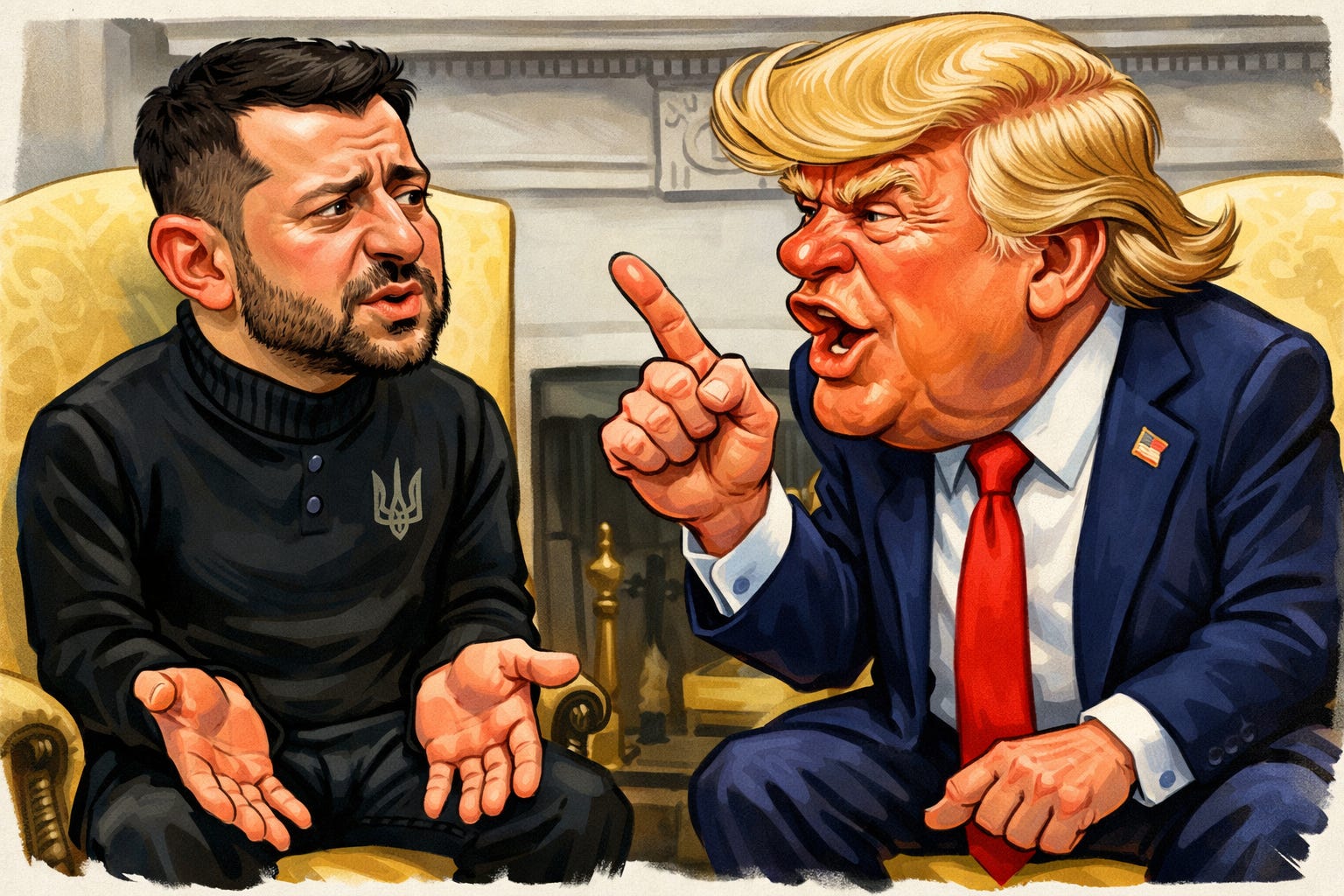
This paper grows out of a set of related questions that I find difficult to avoid in the present political moment. How did the language of diplomacy move from the careful and procedural to what now often appears blunt, transactional, even vulgar? How did we move from treaties (nation-states talk to each other through treaties) to what are openly and shamelessly called “deals”? Why has lying become not only acceptable but often effective in this style of statecraft? And what happens when shared legal frameworks are replaced by a highly subjective idea of morality claimed by those in power? I do not claim to give final answers. What I try to do instead is to make these questions harder to ignore, because the shift they point to is not merely strategic. It is linguistic and political at the same time. I think through them using James Thurber’s The Owl Who Was God, recent political practice, and a perspective shaped by the Global South.
I want to begin with the fable, not as literature in the strict sense, but as a way of thinking through a problem. James Thurber’s The Owl Who Was God is useful here. In the story, an owl becomes important because he can see in the dark and answer a few questions correctly. The other animals take this limited ability as proof that he knows everything, and gradually they stop questioning him. When a fox raises a simple question – can he see in the light? – he is mocked and driven away. Later in the story daylight arrives and the owl cannot see. Yet the animals continue to follow him. The story ends in disaster. Thurber is not suggesting that the animals are foolish. What he portrays instead is a political condition in which authority survives not because it is tested, but because testing begins to feel unnecessary. Once doubt is treated as disturbance rather than responsibility, procedure loses value and following becomes easier. The story is less about blindness than about the comfort of following.
For much of the twentieth century, diplomacy tried to avoid such conditions, at least in appearance. It relied on procedure. States negotiated through formal channels, drafts circulated, language was revised repeatedly, and treaties were signed. These treaties were often unequal and shaped by power, yet they imposed a discipline on political speech. Leaders could not speak entirely as they wished; they had to operate within a recognisable diplomatic vocabulary that was measured, sometimes deliberately cautious. This did not make politics moral but it imposed restraint. Restraint was not always justice, but it mattered. What we are witnessing now is not simply a change in geopolitical strategy but a change in tone itself. Diplomacy increasingly sounds less diplomatic, and the shift is audible even before we begin to analyse it.
The treaty, once considered the central instrument of international politics, is now gradually being displaced by the language of the deal. This shift did not occur accidentally. It was pushed into political speech and normalised most visibly by Donald J. Trump, who has repeatedly described international relations in explicitly transactional terms. In Trump’s worldview, the world appears as a space of bargains where outcomes resemble contracts more than commitments. A deal is not a neutral word. It belongs first to the world of business, where bargaining, leverage, winners, and losers are expected. It does not promise durability and can be revised, abandoned, or denied. Outside business, the word also circulates comfortably in the vocabulary of gangsters – you accept, or something follows; there is no appeal and no shared rule. When such language enters diplomacy, it does more than simplify communication. It alters the moral atmosphere of politics itself. Consider how allies and adversaries alike are described as partners who must “pay,” “give,” or risk being “left.” Security begins to resemble a purchasable service, and protection appears conditional. There is a certain perversity in this language. Diplomacy once attempted to restrain power through formality; now power often seems almost proud of speaking without it.
This transformation is closely tied to the weakening of what was long described as the rules-based international order. For decades, Western states presented democracy, liberalism, and procedural rules as universal aspirations, even though these rules were applied selectively and frequently suspended when inconvenient. The Global South did not discover this contradiction late; it lived with it. Yet the pretence mattered because it compelled justification and forced power to explain itself in normative terms. What is striking today is not the exposure of hypocrisy but the fading need to hide it. At the World Economic Forum in Davos, Mark Carney described the rules-based order as a useful ‘fiction’ that benefited the West. The remark was unusually candid, but perhaps what unsettled many was not the statement itself so much as the ease with which it could now be voiced. The fiction had already weakened; the admission merely confirmed its decline.
Trump’s politics fits this moment with unusual clarity because he does not simply violate rules – he questions why they should constrain power at all. Diplomacy becomes less a process of settlement and more a demonstration of will, where agreements are valued for the spectacle of strength they produce rather than for their capacity to endure. Durability matters less than visibility. More troubling still is what replaces law when it is set aside. Law assumes continuity and answerability beyond the moment, whereas Trump frequently substitutes it with a deeply personal language of morality – what he feels is fair, what he believes is right. But whose morality is this, and by what measure can it be assessed? It is neither universal nor stable; it shifts with audience and interest. A morality that cannot be questioned does not restrain power. It shelters it.
The consequences are visible in the treatment of truth. Traditionally, in treaty-based diplomacy, lying carried risk because commitments were recorded and memory was extended beyond the present. However, in a deal-driven political environment, statements need only survive the news cycle. Precision itself becomes a political instrument. When Trump claims to have stopped a specific number of executions in Iran, the number produces the impression of measurable intervention and travels easily through media circulation, while verification becomes secondary. Meanwhile, large-scale deaths – in Gaza, in Ukraine – appear as aggregates, almost statistical. Numbers here do not clarify violence; they organise attention. Some deaths acquire immediacy, while others dissolve into magnitude.
From the Global South, this situation does not feel entirely new. Many societies have lived through political orders where speech overshadowed institutions and personal authority carried more weight than law. Formal structures often existed, but their presence did not always guarantee restraint. Decisions were frequently shaped elsewhere – sometimes behind closed doors, sometimes through informal networks of influence. Citizens learned, often early, that what was written and what was practiced did not always coincide. What feels different now is the location of this style. It is no longer confined to the margins of global politics, nor is it spoken of with embarrassment. It is visible at the centre and is increasingly described as pragmatic, even necessary. Language that once signaled excess – blunt threats, open transactionalism, the casual mixing of statecraft with personal authority – now circulates with surprising ease.
The owl in Thurber’s story is not evil. He is limited, and his limits are revealed too late. The problem lies less with the owl than with his followers, who continue to follow not because they are compelled but because ethics, morality, and hesitation have lost their value, and procedure no longer feels necessary. The movement continues because it has already begun to feel ordinary, and by the time daylight arrives, the habit of following is stronger than the instinct to stop. What is taking shape in diplomacy today follows a similar pattern. Treaties yield to deals, law yields to personal morality, and truth yields to repetition. Power now speaks more directly, sometimes even crudely, and seems less concerned with how it is perceived. Perhaps the real shift is this: politics no longer feels obligated to appear diplomatic. In such conditions, harm rarely arrives as spectacle. It gathers quietly within the language through which power speaks, and by the time it becomes clearly visible, it is already difficult to interrupt.