The Court Order No Court Wrote
India blocked 129 websites on forged High Court orders, and nobody checked.

Some words make things happen the moment they are said. For example, when a judge says “guilty”, a person presumed innocent becomes a convict. When Donald Trump renamed the Gulf of Mexico the Gulf of America, US government maps changed, but Mexico’s did not. The English philosopher J. L. Austin called such words performatives. He argued that they work only under two conditions: (a) the person saying them must have the authority to do so, and (b) they must say them in the proper way. He goes on to say that when anyone else says them, they fail. Austin called such a failure an infelicity.
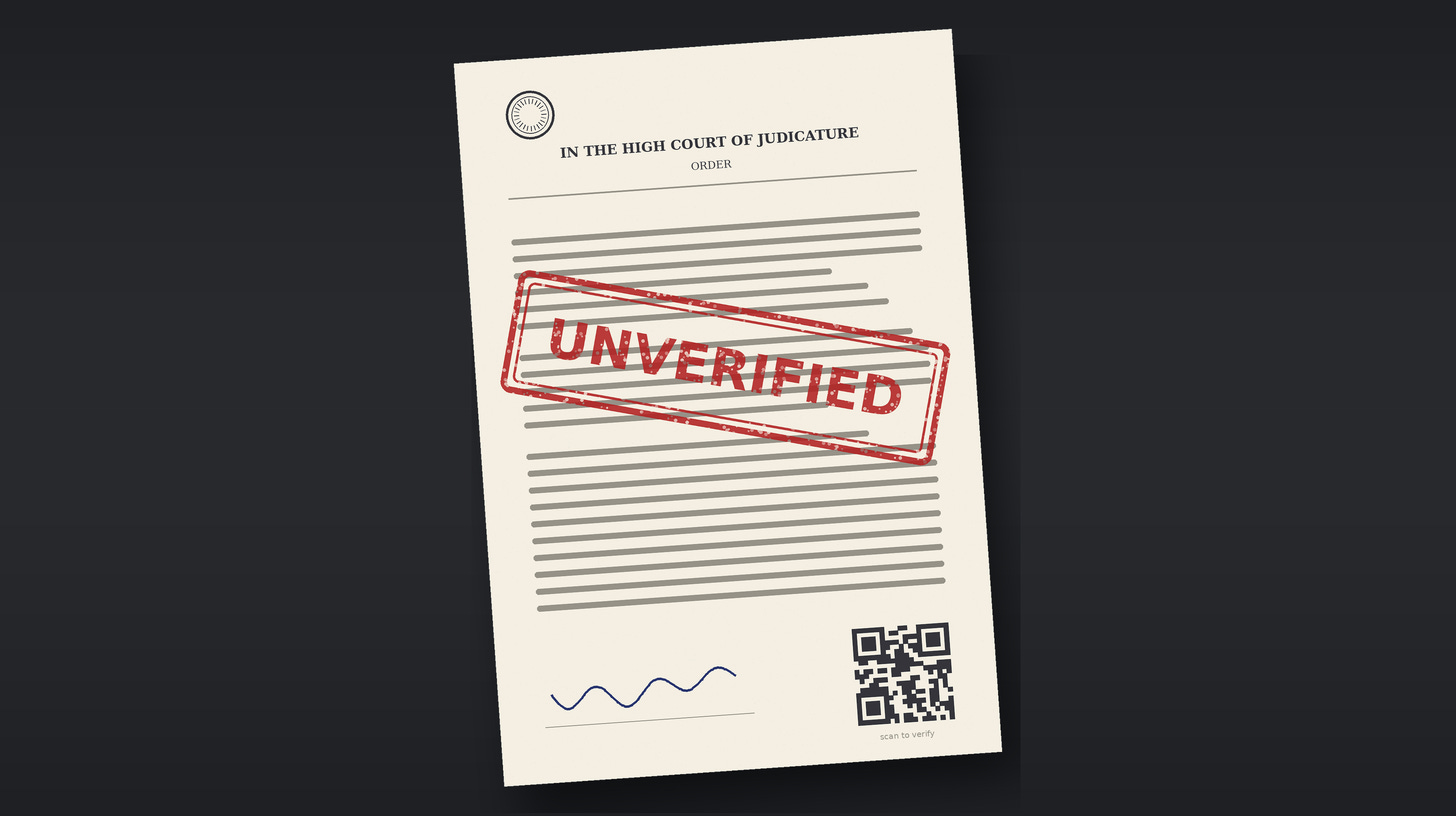
In July and September this year, the Department of Telecommunications told internet service providers to block 129 betting websites. It said it was acting on two orders, one from the Rajasthan High Court and the other from the Allahabad High Court. A later Reuters investigation found that neither court had passed those orders. The papers looked official. They carried a seal, a judge’s name and even a QR code. Going by Austin’s theory, they should have failed. Instead, they worked.
Finding out who forged them is the police’s job. The question for the rest of us is how a court order that no court wrote could pass through a government department and reach every internet service provider in the country. I believe no one asked who was speaking, or more precisely, who was issuing the order. In India, that question is no longer asked once the public has labelled someone a “bad guy”. In this case, the targets were online betting websites. They are the latest in a familiar line of cases, and what the earlier cases share is worth spelling out.
Austin’s rule makes the speaker decisive. Words bind only when someone with the authority to say them says them in the proper way. In the cases I am going to talk about in this piece, the speaker hardly matters. The label on the target does. When a mob kills a man on a rumour that he ate beef, the rumour does the work that a verdict should do. This is not a rare event. Human Rights Watch counted at least 44 people killed in such attacks between May 2015 and December 2018, and found that in almost every case the police at first stalled the investigation or ignored procedure. When the police shoot men accused of rape in a staged “encounter” and the crowd cheers, the accusation takes the place of a trial. This too is routine. Between April 2016 and March 2022, the National Human Rights Commission registered 813 cases of killings in police encounters, roughly one every three days, and not one officer was convicted. When the Uttar Pradesh government put up roadside hoardings in Lucknow in 2020 with the names, photographs and home addresses of people who had protested against the citizenship law, the hoardings did the work of a conviction, though none of them had been convicted of anything. In none of these cases did anyone with the authority to pronounce guilt do so. The public did not seem to mind because the label had already settled the question.
That indifference is useful to the state. If the public will not ask who had the authority to act, officials have little reason to ask either. They have good reason to let the label do their work for them. A betting site can then be blocked on a forged paper. A protestor’s account can be blocked in secret. No one asks by what authority this was done. Austin’s rule has been turned upside down. Whether words take effect now depends less on who says them than on whom they are said against. We know about this case only because this one paper was made public.
Austin seemed to assume that someone would always be there to notice when the wrong person spoke. The French philosopher Jacques Derrida, replying to him in an essay called “Signature Event Context”, pointed out the weakness in that assumption. A signature, Derrida says, works only because it looks the same each time and can therefore be recognised. He goes further and argues that anything that can be recognised can also be copied. Think of your signature on a cheque. The bank honours it because it matches the one on file, and anyone who learns to make it match can sign in your name. Every signature, then, can be forged. Its only protection is a person who bothers to check it.
The courts know this. Real Delhi High Court orders, which the Department of Telecommunications has itself put on its website, include a line telling readers that they can confirm the order is genuine by scanning its QR code on the court’s portal. I read the QR code, like the seal and the judge’s name, as what Derrida calls a signature. It is the mark that tells a reader who is speaking. The court has printed Derrida’s point on its own paper. This mark can be copied, so check it.
The Indian state runs on paper, and it has every reason to know this. Its orders, certificates and records pass through countless hands. Each pair of hands is a chance to copy them and a chance to check them as well. Such a state cannot claim to be surprised by a forged order. If forgery could have been expected, the failure lies with whoever was supposed to check.
According to Reuters, the forged papers did go through a process. Officials discussed the letters among themselves before forwarding the orders to internet service providers. One email asked for an action-taken report. The orders were then put up on the department’s website. Every step was followed except the one that mattered. Nobody asked whether the court had actually issued the order.
Checking is a moral act before it is a clerical one. Hannah Arendt has a word for such failures. She calls it thoughtlessness, by which she means an inability to think from the standpoint of somebody else. When we ask “is this real?”, we ask on someone’s behalf. It may be the person about to be blocked or the court whose name is being used. Here, it seems no one thought about anyone on the other end, not even the court. The Chief Justice of the Allahabad High Court ordered that a criminal case be registered. The department did not answer Reuters’ questions. Someone used a High Court’s name to give orders to the government, and the government has said nothing about it. Officials do not stop thinking about everyone at once, however. Some people are forgotten first.
Every state decides, usually without saying so, whose case deserves the question “on whose authority?” Most of us never notice, because the decision goes in our favour. It becomes visible at the edges, among people whom the state’s police and orders can reach but whom its proper procedures do not protect. In India, more and more, the crowd draws this line before the state does. Public anger decides who the bad guy is, and institutions learn whom they need not worry about.
In December 2019, crowds in Hyderabad showered petals on the police who had killed four men accused of raping and murdering a veterinary doctor. A commission set up by the Supreme Court later found that the encounter was fake and recommended that the ten officers involved be tried for murder. Even so, after seven of the officers challenged the report, the Telangana High Court in 2024 told the state government to take no coercive steps against them on its basis.
In Dadri, in September 2015, a mob killed Mohammad Akhlaq, claiming he had consumed and stored beef at home. The following year, Ravin Sisodia, one of the men accused of his murder, died in judicial custody. Villagers wrapped his coffin in the national flag and called him a martyr for “Hindu values”. The police and officials present said nothing. In February 2021, during the farmers’ protest, Uttar Pradesh police filed a case against the family of a farmer who had died in a road accident near the Ghazipur protest site because mourners at his funeral had wrapped his body in the same flag. No such action had been taken over Sisodia’s funeral. The rules on using the national flag were the same in both cases. The police enforced them against a protestor’s family but let them pass at the funeral of a man accused of lynching. What decided the difference was the label each man carried. The protestor had been placed among the bad guys, while the accused had not. Earlier this year, I wrote about the politics of selective outrage, and the flag cases show that the law can be just as selective.
The betting sites matter to this argument precisely because nobody cares about them. No one felt outraged by the blocking because the label “bad guy” had already decided how people saw them. Officials received an emailed order, discussed it among themselves and passed it on to internet service providers. The public’s indifference meant that no one outside the department asked whether they should have done so. As far as we can tell, the paper went through because nobody thought its targets deserved the question. A blocked website is nothing like a murdered man, and I am not putting them side by side. What they share is the excuse. The idea that proper procedure is wasted on bad guys was learned on the street. The forged orders show it at work in an office, where it needs no anger at all. That small scale should worry us because a habit that runs without passion runs without anyone choosing it. In an earlier essay, I looked at how language strips people of their standing. With the betting sites, it happened without a word being said.
We know any of this only because the Department of Telecommunications publishes the court orders it acts on. A Reuters reporter found the Allahabad order on the department’s website and wrote to the High Court on 30 October to ask whether it was genuine. The court searched its records and found no such order, so it went to the police. The fraud fell apart because someone checked the signature, which Derrida says is a signature’s only protection. It was not the person whose job it was to check. A reporter outside the department read a public document and asked who had written it.
Most blocking in India cannot be checked this way. When the government itself orders an account or a website blocked, it keeps the order secret, along with the reasons. People who have asked for those reasons through RTI have been refused. Between February 2021 and February 2022, the government ordered X (formerly Twitter) to block 1,474 accounts and 175 posts, many of them about the farmers’ protest. It later told the Karnataka High Court that X did not need to see the review committee’s orders. The 129 betting sites were blocked in the open, which is the only reason we know the orders were forged. The 1,474 accounts were blocked in secret, and there is no public document against which anyone can check them.
One old and simple test of any power used over other people is whether it could survive being exercised in public. A blocking system built on secrecy fails that test by design. This case shows what that costs. The forged orders were caught only because they belonged to the one kind of blocking order the public was allowed to read.
Anyone defending the department, or simply shrugging at the story, will reply that these were gambling sites. The government says it has blocked around 8,400 betting and gambling sites and apps, and their owners put up copies within hours. If that is so, blocking 129 more cost nothing worth worrying about. A more serious objection goes further. A forged order works only because real orders are trusted, just as a fake banknote works only because real money is trusted. The forgery, on this account, tells us about the forger and nothing about the system it fools.
Whether 129 more betting sites matter much is beside the point. What went wrong was the use of power without authority behind it. That is as wrong against a betting site as it is against a newspaper. The betting site only makes it easier to overlook. The more serious objection fails on the courts’ own paper. A court prints a verification line on its orders because it expects forgery. A system that expects forgery and still does not check has stopped working normally. The label “betting” also catches more than it should. Gamban, an app that blocks gambling sites for people trying to stay away from them, was swept up in an earlier crackdown on gambling apps in February 2023, under the secret procedure. It stayed blocked for about three years without a decision, and the government agreed to unblock it only after Gamban took it to the Delhi High Court. Some orders may need to stay confidential, and that can be argued case by case. What I object to is secrecy as the rule.
Let us go back to the court orders themselves. The genuine ones carry a small square of code and a line inviting whoever holds the page to check it against the court’s own records. The court is asking a question on its own behalf in advance. Is this really us? The forged orders had a QR code too, and no one has said whether anyone scanned it. What we do know is that the question went unasked for weeks. Someone outside the government finally asked it because the page was public. The orders that are never published carry the same question, and none of us can ask it.
Discussion about this post