

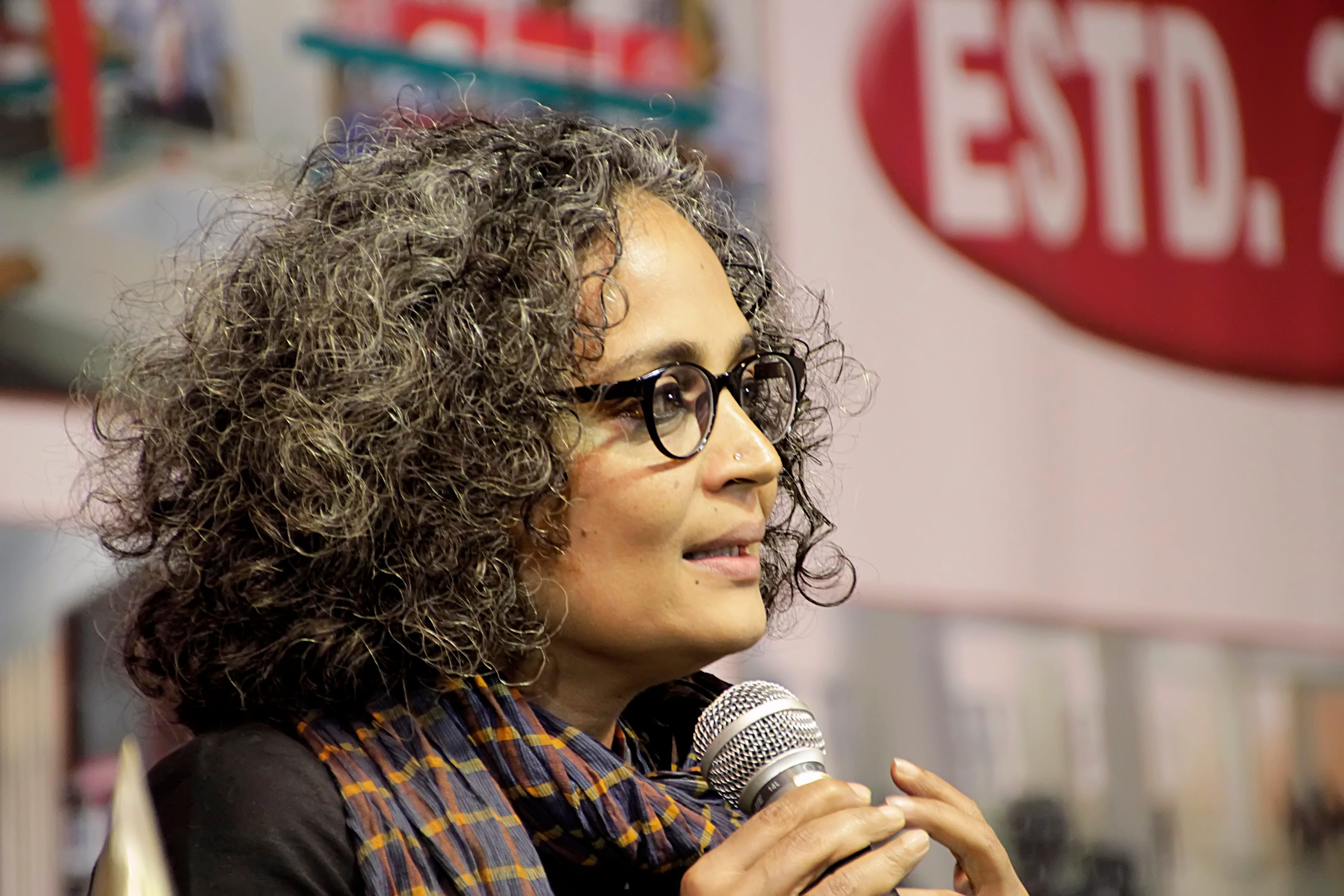
A few days ago, when Booker Prize–winning author and activist Arundhati Roy withdrew from the Berlin Film Festival, it made headlines in major publications around the world. Roy called out members of the jury of the Berlin Film Festival and wrote:
“This morning, like millions of people across the world, I heard the unconscionable statements made by members of the jury of the Berlin film festival when they were asked to comment about the genocide in Gaza. To hear them say that art should not be political is jaw-dropping. It is a way of shutting down a conversation about a crime against humanity even as it unfolds before us in real time – when artists, writers and filmmakers should be doing everything in their power to stop it.
Let me say this clearly: what has happened in Gaza, what continues to happen, is a genocide of the Palestinian people by the State of Israel. It is supported and funded by the governments of the United States and Germany, as well as several other countries in Europe, which makes them complicit in the crime. If the greatest filmmakers and artists of our time cannot stand up and say so, they should know that history will judge them. I am shocked and disgusted.”
Roy’s unapologetic condemnation quickly sparked reactions across media and social platforms. Her statement travelled quickly, and so did the reactions to it. Some defended Roy, while others came out in support of the jury. I must say, criticising Roy is not unusual – she faces many attacks from right-wing members in India for her principled stand on several issues. Roy’s statement ignited debate that soon shifted from cinema to geopolitics. Questions about what can be said on stage and what can be silenced began to be discussed on social media and in mainstream media alike. Along with this, the question of whether art can be neutral also surfaced.
I am not interested in the immediate controversy. What interests me is what this controversy reveals about us as individuals and about the institutions we otherwise cherish. The Berlin episode becomes important when we place it alongside other recent developments. It helps us see how outrage is selectively applied, and how institutions and individuals react to certain cases with decisiveness and to other cases with reluctance. What troubles me is not disagreement – disagreement is normal. What is not normal is the ease with which we use and justify uneven moral language. How quickly people rally behind favored causes, while exercising careful restraint toward others. My point is that this restraint is neither accidental nor innocent. It teaches us something about power.
Let us go back to the Russia–Ukraine war. When Russia attacked Ukraine in 2022, much of the world and Western cultural institutions responded with conviction – that it was a war of aggression against a sovereign nation. Many Western countries soon began boycotting Russian sportspeople, musicians and others. Sports federations and film festivals joined in and started excluding Russian participants from their institutions. I am not questioning the reaction of these institutions. Russia did attack a sovereign nation, and that is against settled international norms – at least on paper. My concern is not the boycotts and sanctions themselves – cultural or political. My concern is why the same principle is not invoked across conflicts where a big power, especially a Western ally, does something similar to its neighbours. If cultural institutions can take a moral stand in one case, it means they are capable of doing so. The question then is not about possibility, but about willingness.
Take, for example, the Gaza war. When questions were raised about the participation and possible boycott of Israel, these very institutions took a different stand – that such events are non-political and should not be linked to or judged according to what governments do. Western commentators who have long preached democracy and the rule of law took a different stand when it came to the rulings of the International Criminal Court. When the court issued arrest warrants against Vladimir Putin, the West welcomed the decision and said that international law applies even to the powerful. However, when the same court issued arrest warrants against Benjamin Netanyahu and other Israeli leaders, the same West questioned the court’s jurisdiction. The United States, which hails itself as a champion of international law, even sanctioned the prosecutor Karim Khan and criticised the court.
For many of us who grew up believing that international law, though imperfect, still meant something, this reversal is not minor. If law applies only when it aligns with strategic interests, then it looks less like law and more like leverage. This pattern did not begin with Ukraine or Gaza. Long before these two conflicts, when the United States invaded Iraq in 2003 without clear UN backing, the language of international law – especially in the Western hemisphere – became feeble in similar ways. When the war in Yemen created one of the worst humanitarian crises in recent times, the moral urgency in many Western capitals was noticeably softer. The difference was not in the scale of suffering alone, but in who was involved and who was allied with whom.
When I point out these patterns, my aim is not to equate these conflicts or reduce their historical significance. I am also not drawing parallels between the Russia–Ukraine war and the Israel–Gaza war. They emerge from different contexts. The regional histories, the scale of destruction and the actors involved are different. For me, the issue is not to draw parallels, but to observe how universal principles of law and democracy are selectively applied. I am not looking for perfect consistency in a world that is messy and unequal. But when institutions speak in the language of universality – human rights, sovereignty, rule of law – they invite us to measure them by those standards. The disappointment arises from that invitation.
This selective outrage is not just the hypocrisy of one or two countries. It is embedded in alliances, trade, security dependencies and, more importantly, in civilizational narratives. When states speak of international law and human rights, they operate within a strategic framework. Cultural institutions such as film festivals, sports bodies and universities are not outside these realities. These institutions depend on funding, diplomacy and public legitimacy, and their language is shaped by these forces. Perhaps this is how power works best – not by silencing everyone, but by creating different vocabularies for different situations. One vocabulary for adversaries and another for allies. Over time, we internalise these distinctions without even noticing.
The Berlin Film Festival and Roy’s withdrawal from it expose this tension between cultural institutions and their dependence on political power. When the jury suggests that art should not be politicised, it is, in Roy’s words, “shutting down a crime against humanity even as it unfolds before us in real time.” For me, the question is not whether art is political or not. The question is why political expression is tolerated in one case and not in others. Why is the West – and more recently, the right-wing phenomenon across many societies – selectively outraged? The question then is: what does this entail for us – as individuals and as societies? When the principles behind such outrage appear strategic, the outrage itself loses meaning. It makes people cynical. The assumption that follows is that every moral claim serves an interest. That erosion of trust is what should worry us.
This politics of selective outrage, for me, is therefore less about moral principles and the rule of law, and more about hierarchies. If we begin to see the underlying architecture of power, cultural events like the Berlin Film Festival do not create these hierarchies, but they make them visible. The danger is not just the hierarchy itself, but our growing acceptance of it. It slowly corrupts our principles. Once principles become flexible, no one stands securely within them. We see it when certain panels are cancelled and others celebrated, when certain words are condemned while others are amplified – silencing dissent under the guise of neutrality.