

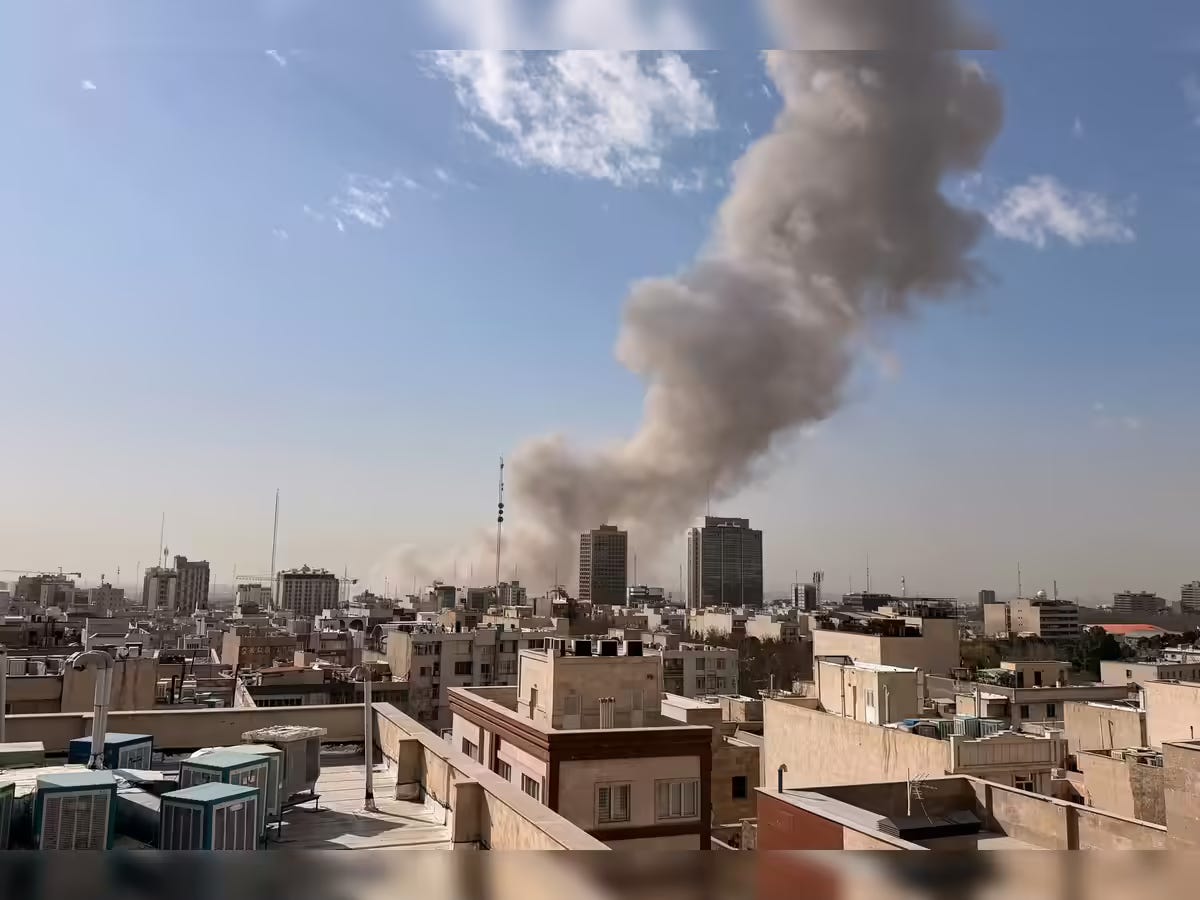
I had finished writing my scheduled essay and was about to publish it when I heard that Israel and the United States launched what they call a ‘pre-emptive strike on Iran.’ My essay was on a rejoinder to Owen Jones’ piece “It would be fine if Israel took it all” – I shall post that soon.
So let me go straight to what I want to say about the ongoing war between US-Israel and Iran.
Before I go any further let me state this in the very beginning that time and again the United States has told the world that it doesn’t care about negotiations and that negotiations and diplomacy mean nothing to them.
Having Said that let me talk for some time about how we should see Trump as a leader. Perhaps he has taken the most important gamble in his presidency. In his address, which he published on Truth Social, he – like Netanyahu – stated that the objective of the war was regime change. And that is exactly what both of them aimed for in the opening salvo: a decapitation strike designed to take out the Iranian Supreme Leader Ayatollah Ali Khamenei, President Pezeshkian, and many other key figures in the leadership and armed forces.
What we know so far is that the Supreme Leader’s compound was hit – explosions were heard near his offices – but Khamenei himself appears to have been moved to a secure location beforehand, and there’s no confirmed word yet that he or the president were killed. To that extent, it is fair to say Trump appears to have suffered a major early setback in the very first instance – unless the US can reverse that calculation through sustained operations. The US and Israel are talking about days, perhaps weeks, of “major combat operations,” with Trump openly calling on Iranians to “take over your government” once the bombing stops, as if this were some liberation script from a bad Hollywood movie.
But let me go back to the negotiations for a minute. This is the second time in less than eight months that the United States has proved itself an unreliable negotiation partner. Just yesterday we were told, by Omani negotiators that, talks were reportedly “close to success” on limiting Iran’s nuclear program – yet Israel, with US backing, intervened to pre-empt diplomacy itself. The buildup was massive and the warnings were loud, but the moment a deal seemed possible, Israel struck Tehran as it had done in the June of 2025. It’s the same script that we saw before: promise talks, then strike when the other side believes them. How can anyone – any state, any movement – trust American word now? This isn’t leadership; it’s gangster diplomacy dressed up as pre-emption.
And let’s be clear that the stated goals are regime change, plain and simple. Trump said it outright - “the hour of your freedom is at hand,” urging Iranians to rise up while US and Israeli jets pound military sites, nuclear facilities, and leadership targets. Netanyahu echoes it, calling the operation a removal of an “existential threat” from the “terrorist regime.” But when you target the supreme leader’s offices and call for the people to overthrow their government mid-bombing, you’re not defending yourself - you’re attempting to engineer collapse from the air. This has all the ingredients to spill across borders – a regional fire that engulfs everyone.
Iran had been for long saying that if it is attacked it will hit all the American bases in the region and it would be an all-out regional war. Why wouldn’t Iran do that, if one were to put oneself in Iran’s shoes? When you are facing an existential threat, the only logical conclusion for the Iranian regime will be to pull the entire region into it. So that is what we saw: attacks on Bahrain, Kuwait, Qatar, Saudi Arabia, UAE, Jordan. Perhaps Oman is the only country in the GCC that hasn’t been attacked yet. We now know that the US 5th Fleet headquarters housed in Bahrain were struck – smoke rising, videos circulating of explosions near the base. Some reports suggest that Al Udeid in Qatar was also hit – though not yet confirmed – and we don’t have much information on what exactly was targeted in the other countries, but the missiles flew, interceptions happened, and the message landed.
Let us now turn back to US and Israel. There are reports that some missiles were fired at the USS Abraham Lincoln – now that is not something a scared country will do, and it is a major escalation. Again, there are reports of multiple impacts in Israel, but the Israeli military censor has made very clear to its citizens that no footage is to be shown to the world – no videos, no photos, nothing that might reveal the real damage or give comfort to the enemy. Classic control of the narrative: keep the home front calm while the bombs fall elsewhere.
Now why am I mentioning all this? Only to make an assumption that what Iran has done so far appears calibrated as a strong warning shot and messaging to the GCC countries, to the US, to Israel. No powerful and modern weapons were used in full force, no all-out barrage of their most advanced hypersonic missiles or swarms that could overwhelm defences completely. But it made it abundantly clear to them that if the need arises, it will not hold back anything. This was the warning shot: we can reach you, we can hurt your allies’ shiny cities and bases, we can turn your “secure” havens into war zones. Next time, it won’t be calibrated.
Now let me come back to Israel and US. Since the opening salvo did not give them the desired results – the supreme leader and president apparently survived, leadership intact enough to order retaliation – this strongly suggests this could become a protracted war. And if Iran turns it into a war of attrition for US and Israel, there is every chance that both Trump and Netanyahu will chicken out. Trump loves the tough talk, the big announcements on Truth Social, calling for Iranians to rise up like it’s 1989 all over again. But when the body bags start coming home, when oil prices spike through the roof because the Gulf is on fire, when his own voters start asking why American kids are dying for regime change in a country that never attacked the US homeland – will he have the stomach for months?
Iran knows this game. They’ve played it before – absorb the hits, bleed the aggressor slowly, let domestic pressure build in Washington and Tel Aviv. The US can bomb from afar, Israel can claim precision, but sustaining “major combat operations” (Trump’s words) against a country that refuses to fold quickly? That’s where gambles turn into quagmires. Diplomacy was discarded for this and now the bill is coming due, and it’s regional.
And let’s not forget what this war could mean for Trump personally, especially with the 2026 midterms looming just months away. Trump came back to power promising no endless wars, America First, focusing on the border and the economy – not shipping more American blood and treasure to the Middle East for regime change fantasies. But here we are again -with another Middle-East war. Polls have repeatedly shown that US voters are fed up with foreign entanglements and some MAGA voices are grumbling about why we’re fighting Israel’s battles again. Trump might think he’s playing the strongman card, rallying the base with decisive action, but history says otherwise: presidents who get bogged down overseas right before midterms usually pay a heavy price at the ballot box. This gamble isn’t just about Iran surviving the first strike - it’s about whether Trump survives politically when voters finally get their say.
This isn’t just about nukes or threats anymore, in fact, I would argue it never was, it’s about dragging everyone into the abyss because two leaders bet they could decapitate a regime from the sky and walk away heroes. History rarely rewards such arrogance.
I’ll finish that Owen Jones rejoinder soon. For now, this war demands we say it plainly: this isn’t pre-emption it’s predation and it’s already backfiring.