

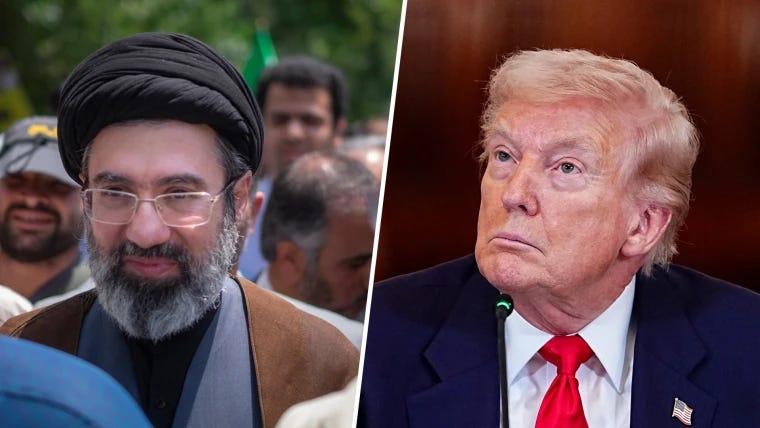
A few days ago Donald Trump brazenly demanded veto power over Iran’s new Supreme Leader while talking to the press. He then went on to say, and has since been saying, that his war of choice is ahead of schedule. He also claimed that Iran has been asking for talks. Which Iranian officials have vehemently denied, in fact they have said they are not interested in negotiations with United States. This kind of hyperbole is nothing strange for Trump. If he has shown anything during his tenure as president, it is his ability to lie – the liar-in-chief of the United States.
Now the Iranians have elected Ayatollah Mojtaba Khamenei, son of the assassinated Supreme Leader and in doing so they have told Trump to go fuck himself in the clearest terms. Trump called him unacceptable. They picked the one man he hated most to show the world that Iran is sovereign and no one dictates terms to it. Mojtaba does not have the traditional qualifications of becoming a Supreme Leader, yet they made him. They ignored both his qualifications and his father’s instructions against it, only to tell US that no one tells them what to do.
But in selecting Mojtaba they essentially told Trump that they don’t care what he says or thinks. Trump has said a lot since then, but one thing is certain that he is desperately looking for an off-ramp. And if reports are to be believed, The Washington Post has reported that Israel is also looking for an off-ramp, but Iran is essentially saying that you don’t get to decide that. From an Iranian perspective, Israel and the US started the war and Iran will decide when to end it. Iran has a plan and they are going according to that, they will keep targeting GCC countries as long as those countries house US bases.
In Mojtaba Khamenei, the US now faces a leader harder and more IRGC-embedded than his father. And interestingly enough, the Iranian people and the armed forces have overwhelmingly pledged their allegiance to the man whom Trump said would be unacceptable. That is not to say that everyone in Iran believes he will be good for the country. Iran is not a homogeneous country – no country is. Not all Americans approve of Trump, or for that matter not all Israelis approve of the war criminal Netanyahu. But one thing is clear: Iran has proved that its system has continuity. At the same time, calculations in Tehran may change as well – this all depends on whether Iran will survive the current onslaught. The only real barrier between Iran and the nuclear bomb was Ayatollah Khamenei himself, whose long-standing fatwa declared nuclear weapons haram and forbidden under Islamic law. Since the US assassinated him right at the beginning of this war, Mojtaba might very well revisit that fatwa – or set it aside entirely – in the name of regime survival and deterrence.
And that continuity matters, because despite the rhetoric coming out of Washington and Tel Aviv, regime change in Tehran is unlikely. Removing the Islamic Republic would almost certainly require a large-scale ground invasion. It is difficult to imagine the United States undertaking such an operation given the enormous military, political, and domestic costs involved. The more important question therefore is not regime change in Iran, but the broader regional consequences of the war – particularly for Israel and the Gulf Arab states.
Iran’s response has been asymmetric and regionally focused. Rather than limiting the conflict to Israeli territory, Tehran has expanded the battlefield across the region. Missile and drone strikes have targeted U.S. military assets and infrastructure connected to Washington’s presence in the Gulf. Some attacks reportedly hit areas linked to the U.S. Navy’s Fifth Fleet headquarters in Bahrain, while others affected oil facilities in Saudi Arabia and infrastructure in the United Arab Emirates, Qatar, Kuwait, Jordan, and Oman.
The economic implications are immediate. Gulf states rely heavily on stable energy exports, trade routes, tourism, and imported goods. When ports, airports, or oil infrastructure are disrupted, the effects are felt quickly. This creates pressure on governments whose legitimacy rests largely on their ability to deliver stability and prosperity.
From Tehran’s perspective, the strategy appears deliberate. Iran has tried to shift the costs of the conflict outward, particularly onto U.S. allies in the region. Rather than confronting the United States directly, Iran relies on drones, missiles, and allied militias to stretch the conflict and impose costs over time.
Several proxy actors have been activated as part of this approach. Hezbollah has opened a front from Lebanon against Israel. Iranian-aligned militias in Iraq have targeted U.S. bases. The Houthis have threatened shipping routes connected to the Red Sea. Taken together, this resembles a strategy of attrition. The aim appears to be to stretch the war, exhaust defensive systems like Patriot and THAAD interceptors, and increase political and economic pressure on states aligned with Washington.
For Israel, this means the conflict is unlikely to remain limited to Gaza or even to Israel’s borders. The opening of additional fronts and the involvement of Iranian allies risks turning the war into a prolonged regional confrontation. Even if Israel retains military superiority, sustaining multiple fronts over time carries heavy economic and security costs.
As far as for the Gulf monarchies, the situation may be even more complicated. On one hand, their security systems remain deeply tied to cooperation with the United States. On the other hand, hosting American bases now exposes them to direct retaliation from Iran. Facilities in Bahrain, Qatar, Kuwait, the United Arab Emirates, and Saudi Arabia have already been targeted or placed under threat.
This raises an uncomfortable question for Gulf governments – whether American bases still guarantee security, or whether they have become magnets for retaliation.
The Gulf states now face a truly difficult situation – they are literally caught between the devil and the deep sea. They have two main options, and neither looks good for them. They could attack Iran and fully join the US-Israel war, but most of these states are family dictatorships. They know their people would turn against them in outrage, potentially causing their regimes to fall like a pack of cards. Or they could ask the US to vacate the Middle East and remove its bases, but that too is a difficult and risky option that would upend decades of security arrangements. At this stage, the only thing they can really do is issue condemnation statements against Iran while hoping the storm passes. But by the time this war ends – and if Iran survives, which I believe it will – this would mark the end of American hegemony in the Middle East. In a way, the loser in this war won’t be Israel, it won’t be Iran, but it will be the United States.
There is also a domestic dimension. In countries such as Bahrain, protests have appeared in Shia-majority areas following strikes near the U.S. Fifth Fleet headquarters and the killing of Khamenei. Security forces have responded with arrests and force, while Gulf Cooperation Council troops reportedly entered Bahrain to assist authorities. The situation echoes earlier moments in the region when external conflicts triggered internal political tensions.
If the war continues, similar pressures could emerge elsewhere. Saudi Arabia’s Eastern Province, where much of its oil infrastructure is located, has a significant Shia population. Iraq already hosts powerful Iranian-aligned militias. Lebanon is vulnerable because Hezbollah has entered the conflict. Even states such as Jordan could face domestic pressure because of economic strain and public anger over regional developments.
If Gulf states begin to conclude that hosting American forces brings as much risk as protection, they may start quietly reassessing their security arrangements. Some could seek adjustments to basing agreements or diversify partnerships with other powers, including European states or even China.
In the end, the Islamic Republic may well survive this war even if it emerges weakened. The assumption in Washington and Tel Aviv that pressure and escalation will produce regime change in Tehran may prove misplaced. Iran’s system has shown before that it can absorb shocks and continue functioning.
The more immediate consequences of this war may therefore appear not inside Iran, but across the region. Israel could find itself trapped in a prolonged multi-front conflict, while Gulf monarchies may discover that their close alignment with Washington carries far greater costs than they anticipated. American bases that were once seen as shields are now becoming targets, and governments that once relied on stability may soon find themselves managing unrest and economic disruption. Maximum pressure has become maximum embarrassment.