The Ummah Is Not the Kingdom
On Yemen, Mecca and the borrowing of the sacred

It has been a while since I last wrote here. What brought me back is one sentence from the head of the Organisation of Islamic Cooperation, which I could not gloss over.
On 25 October, the head of the Organisation of Islamic Cooperation described the Houthi attacks on Mecca and Medina as an assault on the entire Muslim ummah. On its own terms, the statement is difficult to dispute. Mecca is the direction towards which Muslims around the world turn to pray, and Medina holds the grave of the Prophet; if a drone was in fact aimed at either city, and the Houthis insist that none was, then it was aimed at something which belongs to far more people than the state that happens to surround it.
Three days later, Saudi jets struck a market and a fuel station in al-Hazm, a town in Yemen’s north, and killed fourteen people. A week earlier, the same sources had reported more than a hundred Saudi strikes in a single day across Sanaa and seven other governorates. Both figures come from Houthi-run television and should be read with caution, since no independent body has yet counted this autumn’s dead. Nobody, however, denies that Saudi bombs are falling on Yemen again, and the OIC has not described the strike on al-Hazm or any of the others as an assault on the ummah. The people in that market were Muslims too, and many of them pray in mosques older than Saudi Arabia itself. Who decided, then, that the ummah stops at the Saudi border?
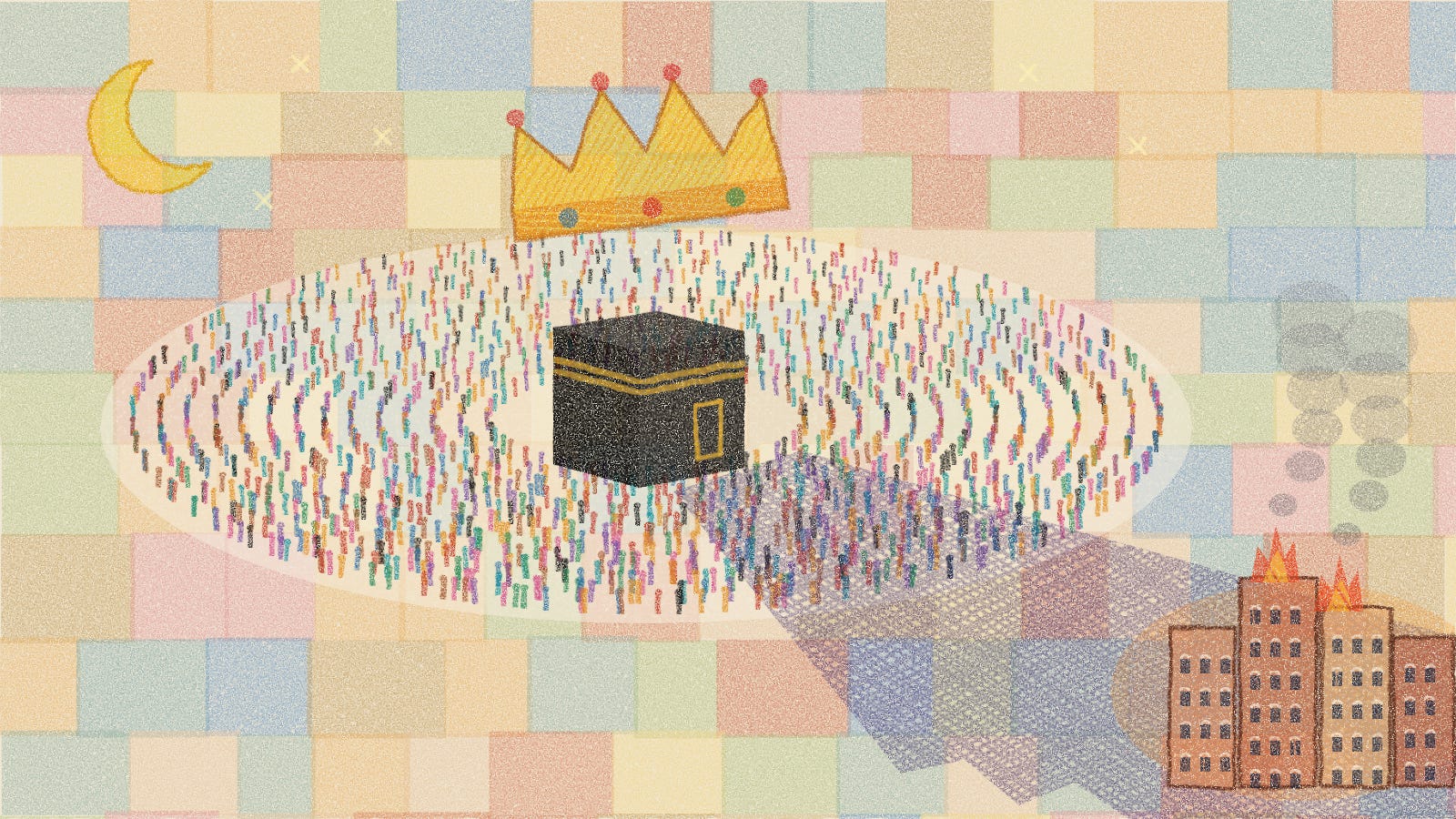
I would argue that the problem begins with a confusion that has become so ordinary that it is rarely noticed. For a great many governments and for a great many ordinary Muslims, the House of Saud has come to stand in for Islam, and the kingdom for the ummah. No one says this in so many words. The equation takes shape through a series of statements, each of which sounds reasonable on its own.
Take, for example, the Grand Mufti of Saudi Arabia. On 24 September Sheikh Saleh al-Fawzan, a royal appointee given the office by King Salman barely a year earlier, addressed the Saudi troops stationed on the Yemeni border. He told them to obey their rulers and commanders and to be ready to give their lives, and he assured them that in defending the holy places they were following in the footsteps of the Prophet’s Companions; the Houthis, he said, were founded on a corrupt creed. The soldiers he was speaking to are guarding a border while an offensive they support pushes towards Sanaa, and yet the Mufti, in a single sentence, relocates them to the gates of the Kaaba and places their enemy outside the faith. A war over territory and shipping lanes, coming after ten years of failed intervention, is thereby turned into a war for the house of God.
The name of the new alliance offers another example. In August, Saudi Arabia, Turkey and Pakistan signed a mutual defence pact in Mecca, which Pakistan now calls the Makkah Alliance. I have no quarrel with the alliance itself. In fact, I believe the Middle East needs a bloc of this kind if it is to survive, and I believe Iran ought to be part of it. My objection is to the name. When a military alliance is named after the holiest city in Islam, any question about how that alliance is used begins to sound like a question about Mecca, the sacred place itself. Moreover, once the alliance is presented as the ummah closing ranks against the Houthis, and behind them against Iran, an arrangement that might one day have included Tehran is recast as a front against it before it has properly begun.
The same confusion appears in its crudest form on social media. I keep running into people there for whom anything Yemen does is an outrage and every Yemeni a barbarian, and their reasoning runs in a straight line: the Houthis attack Saudi Arabia, Saudi Arabia guards Islam’s holiest places, therefore the Yemenis are attacking Islam, and no Muslim should support them. I do not believe that most of them have reasoned their way to this position. The holy cities matter enormously to Muslims, and the Saudi state has stood in front of them for so long that many can no longer see the one without the other. What troubles me is the slide within that reasoning, from the Houthis to the Yemenis, from an armed movement to an entire people, because it is precisely through such a slide that a whole nation is written out of the ummah.
Riyadh’s selective use of the ummah is difficult to accept. It is the same kingdom that led the intervention in Yemen in March 2015, a war that by the end of 2021 had killed an estimated 377,000 people, according to the UN Development Programme. Around six in ten of them died away from the fighting, of hunger, disease and the lack of clean water and health care, and most were children under five. The Saudi-led coalition is not responsible for every one of those deaths; nevertheless, its airstrikes caused about two-thirds of the civilian deaths recorded by the monitoring group ACLED up to 2019, and its restrictions on Yemen’s ports were widely blamed for deepening the hunger. This year the UN counts 22.3 million Yemenis in need of aid, 18.3 million without enough to eat and 5.2 million driven from their homes. They too belong to the ummah, and nobody in Riyadh has described their suffering as an assault on it. It is the same kingdom whose agents killed the journalist Jamal Khashoggi inside its consulate in Istanbul in October 2018 and dismembered his body, in an operation that US intelligence says the crown prince approved. It is the same royal family that has relied on Western capitals for its security for decades, and whose crown prince, as recently as September, asked Donald Trump to fight the Houthis for him. And it is the same kingdom that has opened its doors to mass tourism, concerts and a westernised public life while continuing to lecture the rest of the Muslim world about Islam and to warn that Islam is in danger whenever the kingdom is. Nobody was asked to defend the ummah when a journalist was killed in a consulate, or when Riyadh went looking for American protection. Islam is invoked only when the fight is the kingdom’s own and the enemy belongs to a different sect.
The selectiveness is even more apparent in the case of Palestine. Since October 2023 Riyadh has watched Gaza being flattened. It has not been silent: it hosted summits, and in November 2024 the crown prince called Israel’s war a genocide. But Gaza received communiqués, whereas Yemen has been given a Grand Mufti telling young men to be ready to die. Nobody in Riyadh called the bombing of Gaza’s mosques and hospitals an assault on the entire ummah, and no alliance named after Mecca was mobilised on behalf of the Palestinians. Before October 2023 the kingdom was reportedly close to normalising relations with Israel. It now insists that there can be no deal without a Palestinian state, yet the contacts never really stopped, and last month Trump claimed that normalisation was back on the table and that the Saudis were pleased with Israel’s help against the Houthis. The kingdom, in other words, remembers the ummah when it is itself under attack and forgets it when the Palestinians are.
The arrangement is more recent than many people seem to remember. Saudi Arabia was declared a kingdom only in 1932, and the Saudis took Mecca and Medina by conquest in 1924 and 1925. For four hundred years before that the holy cities had been Ottoman, and the Ottoman sultan styled himself their servant rather than their master. My great-grandparents in South Asia lived in a world in which the Saudis had nothing to do with the Haramain.
That generation also had opinions about the change, and they voiced them. South Asian Muslims had committed themselves to the Khilafat movement in defence of the Ottoman caliphate, and when the caliphate was abolished in 1924, the question of who would hold the Hejaz became as much a South Asian question as an Arab one. Many Khilafatists in fact welcomed Ibn Saud at first, on the understanding that the holy land would be governed in consultation with Muslims everywhere, and in 1926 he convened a congress of Muslims in Mecca. The consultation never came. In the spring of that same year the domes and tombs of Jannat al-Baqi in Medina, where members of the Prophet’s family and many of his Companions are buried, were levelled. Muslims across the subcontinent, Shia and Sunni alike, protested, and some of the men who had welcomed Ibn Saud went home disillusioned.
I recall the Baqi for what it shows about those years. A century ago Muslims far from Arabia did not assume that whoever held Mecca spoke for them; guardianship of the holy cities was something to be argued over. Even the royal title, Custodian of the Two Holy Mosques, is recent. King Fahd adopted it only in 1986, at a time when revolutionary Iran was questioning the kingdom’s Islamic credentials. It was a claim, and there was a time when Muslims questioned it. Somewhere along the way, that questioning stopped.
The ummah has never had a capital or a royal family. Many powers have tried to speak for it, from the Ottomans to revolutionary Iran to ISIS with its self-declared caliphate, and none has managed to own it, which is precisely why the idea retains such pull. At most, the Saudis hold the holy cities in trust. They have done real work as trustees, spending fortunes to expand the mosques and to host millions of pilgrims a year, and that deserves to be acknowledged. A trustee who uses what he holds for his own ends does not become its owner. He abuses the trust. When the holiness of Mecca and Medina is lent to a ground offensive on Sanaa or to the demand that soldiers obey their rulers, it is being spent on the kingdom’s politics. Everyone in whose name that trust is held has the right to object, and that is exactly the right this confusion takes away, since if the kingdom is the ummah’s shield, then whoever criticises the kingdom must be attacking the ummah.
Yemen has particular reason to resent being pushed outside the fold. Traders and scholars from Hadhramaut, in the south, carried Islam across the Indian Ocean to the Malabar coast, East Africa, Java and Aceh, and a great many Muslims in our part of the world received their faith along that route. In the north, Zaydi imams ruled intermittently for more than a thousand years alongside Sunni neighbours with whom they long shared mosques, and Zaydism remains the Shia tradition closest to Sunni law. When a Grand Mufti calls it a corrupt creed in a speech to soldiers, he is handing them a religious reason to shoot.
None of this makes the Houthis innocent. This year they have fired missiles and drones at Saudi cities and oil installations, wounding scores of civilians, and they continue to hold aid workers in detention. They tell their fighters that they are waging God’s war, and the movement’s own name, Ansar Allah, means the Supporters of God. Whether they ever aimed at Mecca or Medina I cannot say, since the coalition says they did and the Houthis deny it every time; what is clear is that they have never been shy of using religion for power. The principle, therefore, has to cut both ways. No armed group owns the sacred, whether it flies a royal flag or a revolutionary one. The holy cities belong to the ummah, and so do the Yemenis, and neither Riyadh nor the Houthis have the right to decide who is in and who is out.
Why, then, does the confusion survive when it comes apart so easily? Part of the answer is that it is useful. For Riyadh it is a reserve of legitimacy, to be drawn upon when needed. For most of the past decade the crown prince has sidelined the clerics and presented the world with a modern rather than a religious Saudi Arabia; now that Washington will not fight his war and the Houthis are sitting on the Bab al-Mandab strait, the clerics have been called back to the front. Ankara and Islamabad have their own reasons for standing with Riyadh, and the language of the ummah makes that solidarity easier to present at home.
Power, however, is only part of the explanation. For ordinary believers Mecca and Medina are the centre of their devotion, the place one saves for years to see and the direction one faces five times a day, and it is painful to think of the guardian of that place as simply another state, with its own interests and its own air force. Mixing up the kingdom and the Kaaba spares people that discomfort.
That discomfort, I believe, is worth bearing. A woman from Taiz who has saved for years to stand before the Kaaba has as much claim to it as any Saudi soldier and a better claim than any official who invokes its name to justify a war. When a drone is shot down over Medina, she belongs to the community it threatened; when bombs fall on al-Hazm or on her own Taiz, she belongs to that community too. Whoever claims to speak for the ummah has to be able to say both of those things in the same breath, and a kingdom at war cannot.
For readers who want to go further, James Piscatori and Amin Saikal’s Islam beyond Borders (Cambridge, 2019) is the best place to start.
Interesting, and food for thought.
Interesting, and food for thought.