
The Political Grammar of Protest
What the recent student protests in India reveal about democracy, universities and the politics of education.

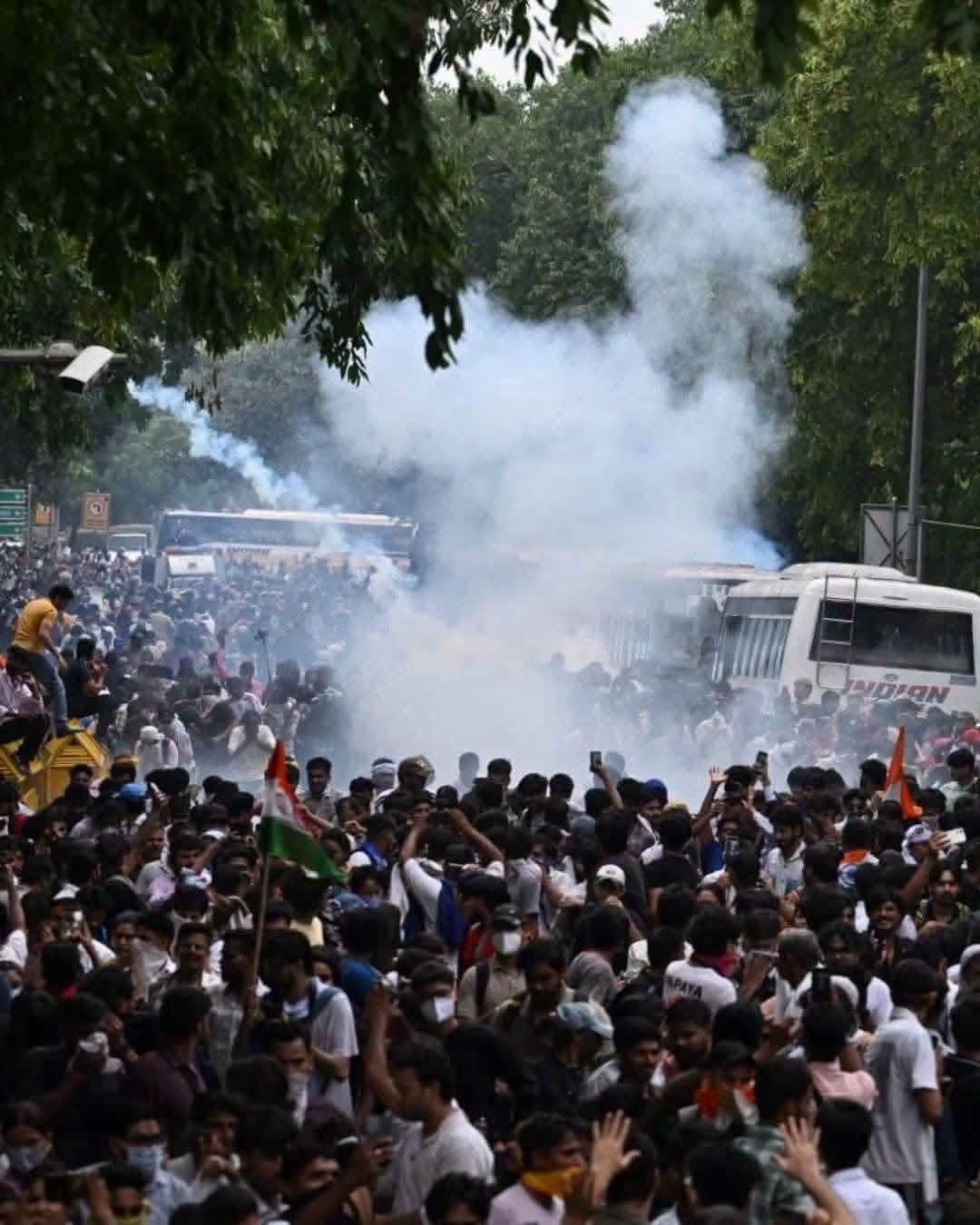
The recent student protests, what has come to be called the Gen-Z protests, and the subsequent resignation of the Union Education Minister, Dharmendra Pradhan, are perhaps the first moment in over a decade when a public movement visibly pushed the BJP onto the defensive. The resignation itself is significant, but what makes this moment politically important is something larger than the mere resignation. For the first time, a protest has imposed a tangible political cost on a government that has come to believe that it is largely insulated from public outrage.
For years, the BJP appeared to operate with two assumptions. The first is that it has successfully won over, or at least neutralised, the institutions and social groups from which it draws much of its political support, particularly the urban middle and upper-middle classes. The second is psychological. Speaking against the government increasingly comes with social and political costs. Whether through public shaming, media trials or the fear of being branded anti-national. These protests seem to have disrupted both assumptions even though briefly.
Yet, the more important question is not what the protests achieved. It is whether they could have achieved much more.
To answer that question, we need to understand the political environment in which this generation has come of age. Over the last decade, India has witnessed remarkably few sustained protest movements. Apart from the protests against the Citizenship Amendment Act and the National Register of Citizens, and later the Farmers’ Protest, there has been little by way of mass democratic mobilisation. Both movements were quickly branded anti-national because they challenged government policy. That language was amplified by large sections of the media until it entered everyday political common sense.
The opposition, too, bears some responsibility. It has failed to create a sustained democratic vocabulary capable of challenging the BJP’s political framing. As a result, almost every criticism of the government is absorbed into the familiar binary of nationalism versus anti-nationalism. An entire generation has therefore come of age without witnessing how democratic movements evolve, how they build political pressure or how they move beyond immediate demands towards institutional reform.
When I say this generation does not fully understand the political grammar of protest, I do not mean it as a criticism of their courage or commitment. Nor do I mean to sound condescending. Political traditions are learned in educational institutes, in universities. They are inherited, practised and passed from one generation to another. This generation inherited a political culture in which democratic protest itself has become exceptional. One cannot learn the language of protest when there are so few opportunities to witness it. That became visible from the beginning the movement centred itself on one demand: the resignation of the Education Minister. The obvious question, therefore, was what comes after the resignation. I rarely heard a convincing answer. Once resignation became the objective of the movement, it had perhaps unintentionally, fixed the limits of its own political imagination.
This is not to diminish what was achieved. For a government that has carefully cultivated an image of decisiveness and political invulnerability, the resignation is no small feat. It demonstrates that public pressure still matters. But resignations, by themselves, do not reform institutions. Paper leaks are undoubtedly a serious problem, and demanding accountability is entirely justified. Yet accountability cannot end with identifying one individual to blame. If the institutional arrangements that repeatedly produce these failures remains untouched, the next crisis is only a matter of when not if.
The larger issue, as I see it, is the gradual centralisation of education itself. Over the last decade, authority over admissions, eligibility tests and entrance examinations has increasingly been concentrated in the hands of the central authority. NEET transformed admissions to medical education. CUET centralised admissions across universities that once conducted their own entrance examinations. Alongside these changes, the National Testing Agency has emerged as the principal body conducting an extraordinary range of examinations that determine the futures of millions of students.
These reforms were presented as measures that would promote transparency, efficiency and uniform standards. Those are worthy objectives. But every institutional reform also redistributes power, and with power comes the question of accountability. When universities conducted their own entrance examinations, responsibility was direct. If something went wrong the university could be held accountable. Today, universities have surrendered much of that autonomy while authority rests elsewhere. Power has become increasingly concentrated even as accountability has become increasingly difficult to locate.
The National Testing Agency sits at the centre of this transformation. It now conducts examinations that determine admission to universities, professional courses and eligibility for teaching and research. Yet public debate has largely been confined to whether it conducts these examinations efficiently. We rarely ask more fundamental questions. Should one agency exercise such extraordinary authority over the educational futures of millions of students? What mechanisms ensure accountability when failures occur?
More fundamentally still, what conception of education lies behind this model?
Education in this country has come to be understood through the language of testing. The examination has acquired an almost unquestionable authority, as though it were a complete and objective measure of merit. But examinations measure only what they are designed to measure. They cannot fully measure curiosity, imagination, judgment, intellectual courage or the capacity for independent thought.
Take the UGC-NET examination for example. It serves as the gateway for postgraduate students who aspire to become researchers and university teachers. Yet we increasingly reduce that aspiration to performance in a multiple-choice examination. One is left wondering what exactly is being evaluated. Does the ability to answer a few objective questions under strict time constraints necessarily tell us who will become a thoughtful scholar or an inspiring teacher? Or have we gradually confused success in a standardised examination with intellectual merit itself? This is not an argument against examinations. Every educational system requires methods of evaluation. The question is whether examinations have come to dominate education itself. We have begun to treat measurable performance as though it exhausts the meaning of learning.
That shift towards merit has other consequence. Universities themselves are gradually being reimagined. They are seen as institutions that process students through examinations, award degrees and produce employable graduates. One needs to understand that universities are not merely degree-awarding institutions. They are among the few spaces in society where disagreement is not only tolerated but necessary. Critical thinking rarely develops within the four walls of a classroom. It grows through conversations after lectures, debates in seminars, arguments in hostels, discussions in libraries and countless informal encounters where students learn to defend their ideas and question authority without fear.
It is therefore troubling that students are so often told they have come to university for education, not politics. This binary, this distinction, is misleading. Politics does not necessarily mean allegiance to political parties. It means learning how power operates, how institutions function, how public decisions affect ordinary lives and how citizens hold authority accountable. These are not distractions from education. They are part of education.
That is why I found the response of several universities during these protests deeply troubling. Rather than recognising protest as a legitimate democratic practice, students were advised to stay away. The language of these advisories often framed protest as disruption rather than participation. Perhaps that is the deeper crisis these protests exposed. We have not merely centralised examinations. We have gradually narrowed our understanding of what education is for.
The conversation this country needs is not merely about who should resign when an examination is compromised. It should be about what we have allowed higher education to become, what we expect universities to produce and whether our obsession with centralised testing has gradually displaced the very idea of education. The political grammar of protest, therefore, will tell us to move from individuals to institutions and from outrage to reform. The recent protests are a step in that direction. Whether we use it to rethink the future of higher education, or allow it to end with one resignation, will determine what this moment ultimately comes to mean.