

We are in the middle of a war, I must add, a war of choice, which the United States willingly took upon itself, not because Iran posed any direct threat to the American mainland but because Israel had President Trump rather firmly under its thumb. As Marco Rubio suggested the other day, it was Israel that took the lead and the United States followed. One might wonder why a global hegemon is taking cues from a state whose own moral footing in the modern world is almost zero. Not that the United States has any moral clarity either.
It is within this context that I want to examine the language we have heard in recent days.
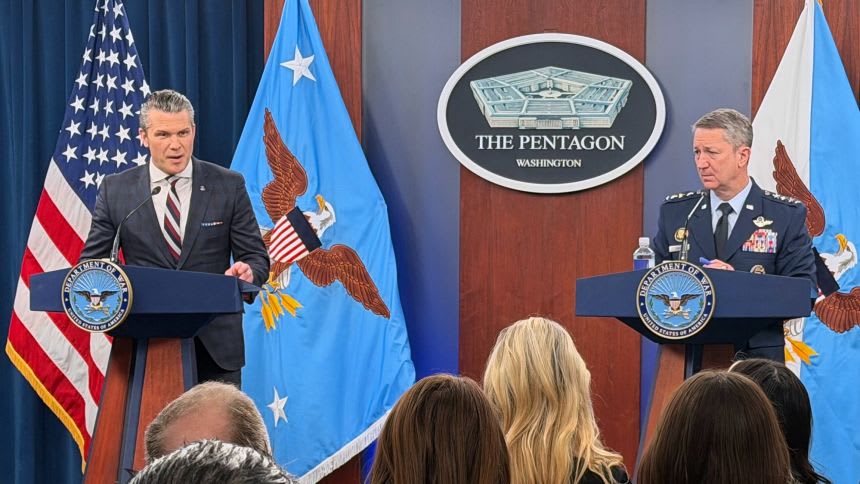
In this piece I will look specifically at the words of Pete Hegseth, the Secretary of Defense, or as he himself seems to prefer, the Secretary of War – and that is precisely what he sounded like at the podium on March 4, 2026, when he was briefing the press. One wouldn’t, even mistakenly, take him as a statesman addressing a grave moment in international affairs, but something closer to a triumphant bully revelling in violence. His language was crude, vulgar, vile, and disturbingly orgasmic. He spoke about death and destruction not with gravity but with visible relish, romanticizing, rather eroticising, the horrors of war as though he were intoxicated by them – almost as if it gave him a thrill.
Let me look at some of the statements he made in that briefing in order to prove my point. Take for example how he chose to open:
“America is winning decisively, devastatingly, and without mercy… They are toast and they know it. Or at least soon enough they will know it. And we have only just begun to hunt, dismantle, demoralize, destroy, and defeat their capabilities.”
This language has no place in the truest sense of diplomatic language; it is rhetoric deeply rooted in the hatred of a people, in this case Iranians, but Muslims in general. How should one look at the words ‘decisively,’ ‘devastatingly,’ and ‘without mercy’? They sound like the words of an arrogant man who is drunk with a sense of orgasmic victory, the destruction of people whom he calls enemies, and finally he dismisses the concept of mercy, a concept that is supposed to temper power, outright. The message that he wanted to send is not merely that the United States is succeeding. The message is that it is succeeding brutally, and that brutality is something to boast about.
Now let me turn to the line that sets the tone for everything that follows:
“They are toast and they know it.”
‘Toast’ is not military terminology. He chose that word deliberately; he did not say that they are defeated, degraded, or strategically neutralized. ‘Toast’ as a word belongs to schoolyard taunts or locker-room bravado. It trivializes annihilation. An entire country’s military and leadership are reduced to something casually incinerated.
What follows is a breathless litany of destruction:
He said and I quote: “We have only just begun to hunt, dismantle, demoralize, destroy, and defeat their capabilities.”
Look at those words, grammatically they belong to the category of verbs, and in his briefing these verbs pile on top of each other: hunt, dismantle, demoralize, destroy. This is in no way careful language of strategy; it reads like someone savoring the process of breaking an enemy piece by piece.
He then went on to a fantasy of absolute, voyeuristic control from the sky – as if a predator looking for his prey. And I don’t use the word predator in any lighter vein. Hegseth describes the air campaign in obsessive detail:
“It means we will fly, all day, all night, day and night, finding, fixing, and finishing the missiles... Finding and fixing their leaders and their military leaders flying over Tehran, flying over Iran, flying over their capital, flying over the IRGC, Iranian leaders, looking up and seeing only US and Israeli air power every minute of every day until we decide it’s over. And Iran will be able to do nothing about it. ...picking targets, death and destruction from the sky all day long.”
This was, at least to me, the most pornographic imagery in his briefing. He went on this rant for some time trying to make the audience feel how powerful the United States is. The endless surveillance, the enemy forced to ‘look up’ in terror, are all the images of a predator looking from the skies at his victims, who are powerless and the predators omnipotent – “all day long.” He made the bombardment of Iranian cities and towns sound like an unending spectacle of control and violation. Hegseth should have also mentioned how the predator hovering above the skies of Minab was looking for his victims – 165 small girls in an elementary school – all because they believed the predator was negotiating with their country and there might be an ounce of morality left in him.
No, Pete, world leaders do not speak in the language of death and destruction all day long – but then one should know the difference when a bigot, a zealot, is given the podium to reassure the world; he would only turn it into a spectacle which gives him a rush, the rush that ecstasy gives to sexual predators. He then went on to celebrate the unfairness and cruelty as an American virtue. Here is what he said:
“Our rules of engagement are bold, precise, and designed to unleash American power, not shackle it. This was never meant to be a fair fight. And it is not a fair fight. We are punching them while they’re down, which is exactly how it should be.”
One might ask whose rules Hegseth was talking about – the rules of a hegemon who has brought only death and destruction to people in the last seven or eight decades around the world. To name only a few from a long list: Vietnam War (1955–1975), Cambodian Civil War (1969–1975), Invasion of Grenada (1983), Bombing of Libya (1986), Invasion of Panama (1989), Gulf War (1990–1991), Kosovo War (1998–1999), War in Afghanistan (2001–2021), Iraq War (2003–2011), Libyan Intervention (2011), Syrian Civil War Intervention (2014–present), Yemeni Civil War Intervention (2015–present).
Look at the vulgar and depraved language he chose, “punching them while they’re down.” This is in no way a political leader’s language; it is a bully-boy’s language celebrating the kick of a fallen opponent. The emphatic “exactly how it should be” drips with sadistic satisfaction, as if mercy itself is weakness. What he was doing on that podium, while the press and the rest of the world were listening, was gloating over asymmetry, turning war-crime logic into patriotic swagger.
He then went on to mock the terror and corpses of the enemy (Iran). He said:
“Iran’s senior leaders are dead…The so-called governing council that might have selected a successor dead, missing, or cowering in bunkers, too terrified to even occupy the same room…That’s not great for morale…The Iranian Navy rests at the bottom of the Persian Gulf. Combat ineffective, decimated, destroyed, defeated. Pick your adjective.”
The sarcasm – ‘so-called,’ ‘too terrified,’ ‘not great for morale,’ ‘pick your adjective’ – reeked of cruelty, mockery, and vileness – of a school bully who takes pride when he bullies the weak mates in his or her school. The use of adjectives felt compulsive, almost masturbatory in its repetition of destruction.
And finally he descended completely into the language of personal revenge.
“Looks like POTUS got him twice.” (on sinking the Solamani, evoking Soleimani) “Iran tried to kill President Trump and President Trump got the last laugh.”
How does one look at the phrase ‘the last laugh’? It belongs to playground feuds and revenge fantasies, not international conflicts. It reduces international conflict to the emotional logic of humiliation and payback. In this rhetoric war becomes not a tragic confrontation between nations but a story of settling scores. For those of us who believe war is one of humanity’s greatest tragedies – something we need to approach with sorrow even when it is unavoidable, Hegseth’s rhetoric feels obscene. Because beneath the sarcasm, beneath the bravado, beneath the lists of destruction, there is a disturbing impression that Pete Hegseth is not merely describing violence. He is enjoying it.