

I listened to Marco Rubio’s speech at the Munich Security Conference. As Secretary of State and National Security Adviser, his words carry not only rhetorical force but institutional consequence. I must admit that at first I did not know how to react, so I read and reread the transcript of his speech. One must admire the confidence and imagination with which he spoke at the conference – the choice of words was fascinating. My first instinct was a sense of dismay but also historical recognition. His speech was a carefully crafted narrative of civilizational nostalgia that seeks to rehabilitate five centuries of Western imperialism as a glorious chapter worth renewing. I must point out that it did not come as a surprise to me; for someone who was born in South Asia, it reminded me of the legacy of British colonialism in the Indian subcontinent, the Partition of 1947, and the epistemic violence that continues, to this day, to shape Global South realities. Rubio’s words represent a textbook example of what Edward Said called “Orientalism1” and what Frantz Fanon described as the colonizer’s refusal to relinquish the “settler’s zone2.”
Rubio romanticized five centuries of Western civilizational triumph through empire building. He spoke of missionaries, pilgrims, soldiers, and explorers “pouring out from its shores to cross oceans, settle new continents, build vast empires.” He framed the post-1945 “contraction” of those empires as a regrettable decline, accelerated by “godless communist revolutions and by anti-colonial uprisings.” What he does not understand is that this language does not just glorify colonialism; it erases the violence that Western civilization inflicted on the Global South.
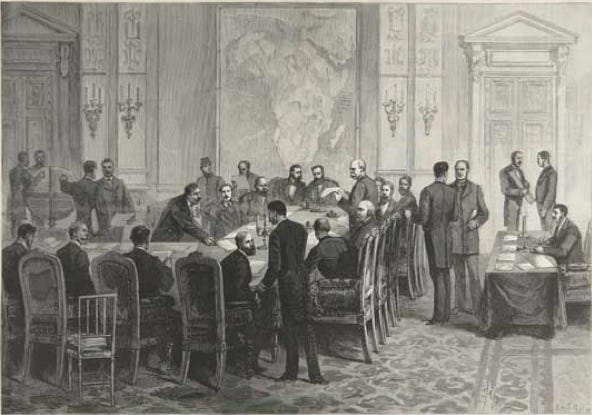
This Western civilization Rubio claims “produced the genius of Mozart and Beethoven, of Dante and Shakespeare, of Michelangelo and Da Vinci,” also produced – though he conveniently ignores it – the Berlin Conference of 1884–85, which carved up Africa like a cake; it also produced the Radcliffe Line, which triggered mass displacement, communal violence, and a conflict that has claimed tens of thousands of lives. In places like Kashmir, those arbitrary lines still fuel unresolved conflict and displacement today. It extracted trillions of dollars of wealth from India alone between 1765 and 1938. It engineered famines that killed tens of millions of people in Bengal in 1770 and in 1943. It presided over brutal repression during the Mau Mau uprising in Kenya and waged a devastating colonial war in Algeria that left deep political and social scars. It dismantled indigenous industries and responded to peaceful demands for self-rule with massacres.
The “anti-colonial uprisings” he pairs dismissively with “godless communist revolutions” were, in South Asia, led by figures like Gandhi and Bhagat Singh; in Kenya by Jomo Kenyatta; in Algeria by Ahmed Ben Bella; and in Ghana by Kwame Nkrumah, along with many other nationalists, socialists, and democrats who represented the subaltern’s refusal to remain objects of history. From India to Kenya, from Algeria to West Africa, these movements were not eruptions of disorder but organized struggles for political dignity and self-determination. By framing decolonization as the regrettable “terminal decline” of “great Western empires,” Rubio presents it as something to mourn rather than something to examine critically.
His invocation of “civilizational erasure” and the need to control borders, while rejecting “a world without borders,” is particularly revealing. The borders he now defends were drawn by colonial cartographers with little regard for ethnic, linguistic, or historical realities – see the Radcliffe Line that bisected Punjab and Bengal in 1947, causing one of the largest forced migrations in human history. Similar arbitrary borders scar much of Africa and the Middle East, legacies that
continue to shape political instability and migration. The very migrants he
fears today are often the descendants of those whose resources and labour built
the prosperity he now claims as exclusively “Western.”
He calls for a “new Western century” of reindustrialization and border control. This echoes the “civilizing mission” that justified empire. He diagnoses the present moment as one that must avoid the “malaise of hopelessness.” Yet the migrants he describes as threats to Western civilization often flee conditions rooted in colonial legacies and unequal global systems – systems the West helped shape.
It is striking that American political life often draws moral authority from stories of exile and repression. Narratives of families fleeing authoritarian regimes become powerful symbols of freedom, resilience, and renewal. They are invoked as proof of the moral superiority of liberal democracy over dictatorship. Yet this moral vocabulary rarely extends to those displaced by colonial borders, extractive economies, or wars shaped by Western intervention – as in Rubio’s own case.
His fascination with restoring the ‘great Western civilization’ does not require the restoration of Western primacy but a multipolar humility. It requires acknowledging that Western civilization was never self-generated. It drew on Arab mathematicians, Indian numerals, African gold, and Asian spices and knowledge systems. It requires recognizing that the “forces of civilizational erasure” today include not only migration but also the erasure of non-Western histories reflected in his own narrative.
I do not write this in anger but in the spirit of the very Enlightenment traditions Rubio claims – reasoned critique. If the transatlantic alliance is to mean anything beyond a refurbished empire, it must make space for the voices of those who were on the receiving end of that history. Let me end by saying that decolonization was not decline; for many in the Global South, it remains unfinished justice.
Edward Said’s Orientalism critiques how Western scholarship, literature, art, and policy have historically constructed “the Orient” (broadly the Middle East, Asia, and other non-Western regions) as exotic, irrational, backward, and inherently inferior - thus justifying colonial domination and cultural superiority.
Frantz Fanon in his book, The Wretched of the Earth, describes colonial society as divided into two irreconcilable zones: the affluent, ordered “settler’s zone” (European quarters) and the impoverished, confined “native zone.” The colonizer maintains this rigid separation through violence and refuses to relinquish or integrate the privileged settler space, even in the face of decolonization.